Best Productivity System for Professionals (And How to Build One)
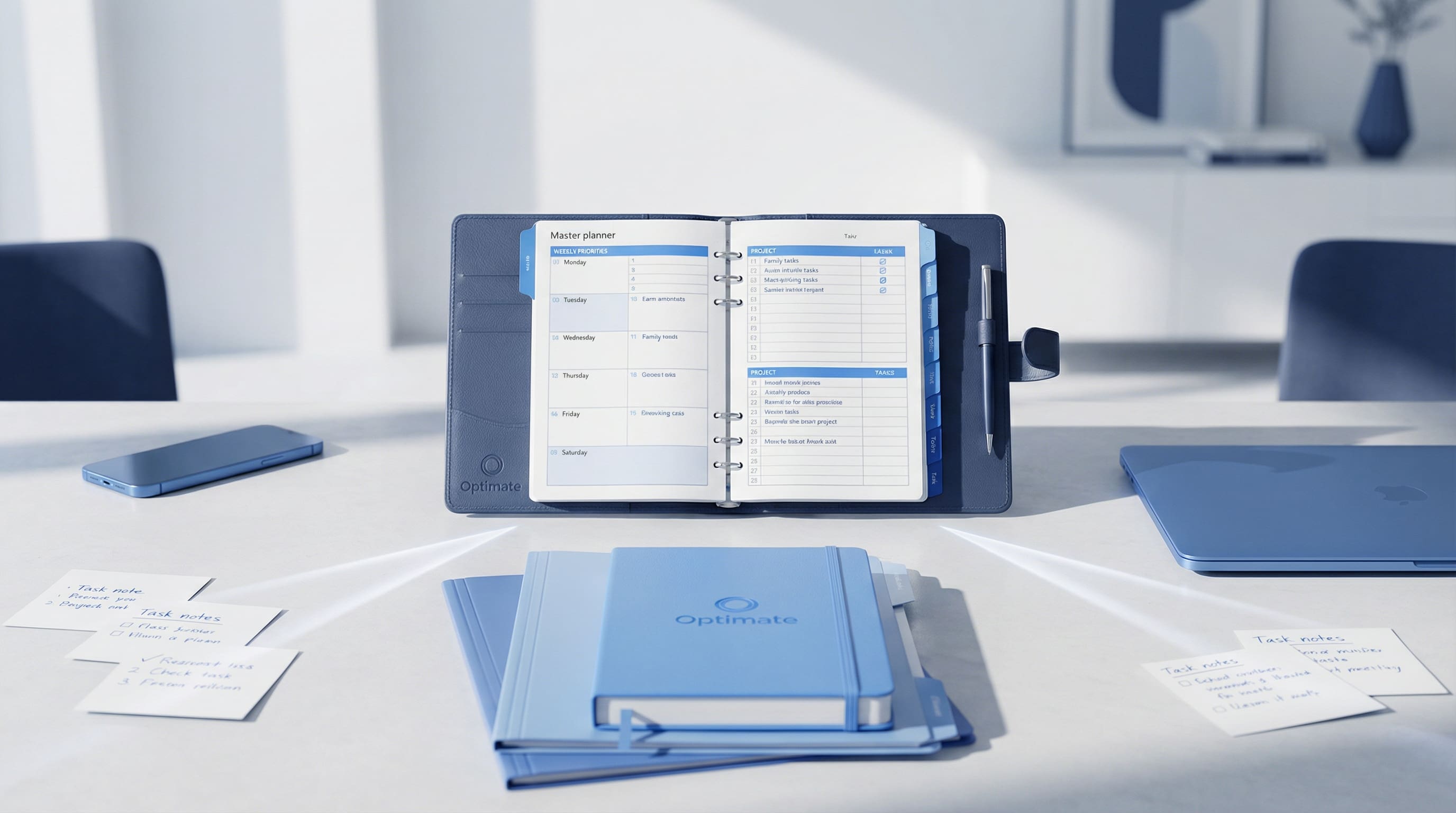
A productivity system for professionals is a structured method for managing inputs, decisions, and outputs at a knowledge-work scale. Unlike consumer to-do apps, a professional productivity system accounts for delegation, cross-team dependencies, and the need to evaluate dozens of incoming requests against strategic priorities, not just personal tasks. It answers not “what do I do next?” but “how does work get prioritized, assigned, and done consistently across everything I’m responsible for?”
The gap between personal productivity advice and what professionals actually need is structural. A project coordinator managing three concurrent workstreams cannot “Pomodoro” their way out of a resource conflict. An operations manager fielding 40 Slack messages before lunch cannot solve the problem by waking up earlier. The tools that dominate the productivity conversation were built for individual contributors, not for people whose output is their team’s output. Everything changes when you stop treating productivity as a personal habit problem and start treating it as an operational design problem.
Why Generic Productivity Advice Falls Short
Getting Things Done, Atomic Habits, the Eisenhower Matrix, and Pomodoro all share one assumption: you are the one doing the work. They help you capture tasks, prioritize your own to-do list, build better routines, and protect your focus time. These are genuinely useful for solo contributors. A software developer, a freelance writer, or a graduate student can benefit enormously from learning to manage their own attention and task flow.
But professionals in leadership and coordination roles often spend more time on other people’s work than their own. You are reviewing deliverables, answering questions, making decisions that unblock three other people, reallocating resources when priorities shift, and translating strategic goals into actionable plans. Your calendar is not yours. Your task list is shaped by the needs of your team, your stakeholders, and the projects you are responsible for. Personal productivity tools were not designed for this operating environment.
The result is a persistent mismatch. You read the book, try the method, and it works for about a week, until a fire drill pulls you out of your time block, or a direct report needs a decision that cannot wait until your “deep work” window. The advice is not wrong. It is incomplete. What you need is not a better way to manage your own tasks. You need a better way to manage how work flows through the people and processes you are responsible for. That is a fundamentally different problem, and it requires a fundamentally different approach. If you manage others, you may also find value in our guide on how to organize work as a manager.
Personal Productivity vs. Operational Productivity
The distinction between personal productivity and operational productivity is the key to understanding why so many capable professionals still feel overwhelmed despite reading every productivity book on the shelf.
Personal productivity is about how you manage your own time, energy, and attention. It answers the question: “How do I get my work done more efficiently?” Tools like task managers, calendar blocking, habit trackers, and focus apps all live in this category. They are inward-facing. They optimize the individual.
Operational productivity is about how work moves through your team, department, or organization. It answers a different question: “How do we get the right work done, by the right people, at the right time, with the least friction?” This involves delegation structures, decision-making frameworks, process documentation, priority hierarchies, and communication protocols. It is outward-facing. It optimizes the system.
Most professionals operate in the operational domain but have only been given personal tools. They are trying to solve a systems problem with individual tactics. It is like trying to fix a traffic jam by teaching each driver to accelerate faster. The issue is not the speed of individual cars. It is the design of the road. When you shift your focus from personal efficiency to operational efficiency, the leverage is enormous. A single process improvement can save your entire team hours every week. A clear delegation framework can eliminate dozens of unnecessary check-ins. A well-defined priority system can prevent the constant re-prioritization that eats up Monday mornings. This is where professionals should be investing their energy.
💡 Key Insight
The Leverage Shift
One process improvement can save your entire team hours every week. One delegation framework can eliminate dozens of check-ins. Operational improvements compound across everyone you work with. Personal improvements only compound for you.
The 4 Types of System Strain
When operational productivity breaks down, it does not break down randomly. The dysfunction tends to cluster into four specific patterns. Understanding which pattern is dominant in your situation is the first step toward fixing it.
Overload strain shows up when there is too much work flowing into your system and not enough filtering. You say yes to every request because there is no clear mechanism for saying no. Your team is stretched across too many initiatives. Meetings multiply because coordination costs increase with every new commitment. The symptom is a perpetual feeling that there is always more work than hours, no matter how hard anyone works. The root cause is not effort. It is intake. You have a volume problem, not a speed problem.
Priority strain appears when everything feels equally urgent. Your team cannot distinguish between what matters this week and what can wait. Stakeholders escalate routinely because they know the squeaky wheel gets the grease. You spend your mornings re-sorting the same list you sorted yesterday because new “urgent” requests arrived overnight. The symptom is constant context-switching and the nagging sense that you are always working on the wrong thing. The root cause is the absence of a shared, explicit hierarchy that everyone can reference without asking you.
Delegation strain is the pattern where you become the bottleneck. Work does not move unless you touch it. Your direct reports wait for your input, your approval, your review. You intended to delegate, but the work keeps coming back because expectations were unclear, or because you never established decision-making authority below you. The symptom is that your calendar is packed with “quick questions” and review meetings, and your own strategic work happens after 6 PM. For a deeper look at solving this particular strain, see our piece on building a delegation framework for team leads.
Process strain emerges when repetitive work is done manually every time. There are no templates for recurring deliverables. No documentation for onboarding. No standard operating procedures for the workflows your team runs weekly. Each person reinvents the approach, leading to inconsistent quality and wasted time. The symptom is that simple, predictable tasks take longer than they should, and new team members take months to become productive. The root cause is that institutional knowledge lives in people’s heads rather than in accessible, reusable systems.
Most professionals experience some degree of all four, but one strain is usually dominant. It is the one creating the most downstream problems and the one worth addressing first.
✅ Try This
Identify your dominant strain before reading further. Which of these four descriptions fits your current situation most closely: overload, priorities, delegation, or process? That answer determines where to focus first.
Building Your Operational Productivity System
Addressing system strain requires a structured approach, not another collection of tips, but a framework that maps directly to the four breakdowns described above. That framework is LEAD: Lighten, Evaluate, Assign, Digitize.
Lighten addresses overload strain. The goal is to reduce the volume of work entering your system to what actually matters. This means building filters: intake criteria for new projects, a process for declining or deferring requests, and an honest audit of current commitments. Most teams are carrying at least two or three initiatives that no one would approve if they were proposed today. Lightening is not about doing less work in the abstract. It is about doing less low-value work so you have capacity for high-value work.
Evaluate addresses priority strain. Once you have reduced the volume, you need a clear, shared system for ranking what remains. This goes beyond a simple urgent-vs-important matrix. Effective evaluation creates a hierarchy that your team can apply without consulting you for every decision. It defines what “urgent” actually means in your context, establishes thresholds for escalation, and gives everyone a common language for trade-off discussions. When evaluation is working, your Monday planning meetings get shorter because fewer things need debate.
Assign addresses delegation strain. This step is about moving decision-making authority and task ownership to the right level. Effective assignment is not just telling someone to do something. It includes defining the outcome, specifying the constraints, establishing check-in points, and, critically, making clear what decisions the assignee can make without coming back to you. Most delegation fails not because the person was incapable, but because the handoff was incomplete. The Assign step provides a repeatable structure for delegation that actually sticks.
Digitize addresses process strain. This is where you take the workflows your team runs repeatedly and turn them into documented, reusable systems. Templates, checklists, standard operating procedures, and automated notifications are the tools of digitization. The goal is to convert tribal knowledge into organizational knowledge. When a process is digitized, it runs consistently regardless of who executes it, new team members can ramp up quickly, and you free up cognitive overhead that was previously spent remembering how things are supposed to work.
The LEAD framework is not sequential in the sense that you must finish one step before starting another. But there is a natural order. Lightening your load first creates the breathing room to evaluate priorities clearly. Clear priorities make delegation more effective because you know what to delegate and why. And well-delegated work is the work most worth documenting into repeatable processes.
How to Diagnose Your Biggest Strain
Not every strain demands equal attention. In practice, most professionals have one dominant bottleneck that is causing a cascade of secondary problems. Someone with severe delegation strain, for example, often develops priority strain as a side effect, because when everything has to go through you, you do not have time to think strategically about what matters most.
The most effective starting point is to identify your primary strain and address it first. The downstream effects often resolve themselves once the root constraint is relieved. You do not need to fix all four at once. You need to find the one that unlocks the most improvement.
We built a free diagnostic that helps you identify which strain is dominant in your current work situation. It takes about five minutes and maps your answers to the four strain types so you know where to focus.
Not sure where to start? Take the free 10-question diagnostic to see where your system is under strain.
Take the Diagnostic →From System to Practice
A framework is only valuable if it translates into changed behavior. Knowing that you have delegation strain does not fix it. You need to actually restructure how you hand off work, define decision rights, and build feedback loops. That implementation step (moving from diagnosis to practice) is where most productivity advice fails. It tells you what to think but not what to do on Monday morning.
The LEAD System Workshop is a 4-5 hour video course designed to walk professionals through the implementation of each LEAD step. It is built around the operational realities described in this article: managing teams, coordinating work, and designing systems that scale beyond your personal bandwidth. Each module maps to one of the four strains, includes concrete exercises, and produces artifacts you can use immediately: priority frameworks, delegation templates, process documentation structures, and intake filters. The goal is not to give you more knowledge. It is to give you a working system by the time you finish.
ℹ️ Note
The LEAD System Workshop launches March 2026. Join the waitlist for early-bird pricing and early access to the diagnostic results guide.
Frequently Asked Questions
What’s the difference between a productivity system and a to-do list?
A to-do list captures tasks. A productivity system governs how tasks enter your attention, how they get prioritized, who handles them, and how recurring work becomes repeatable. A list tells you what to do. A system tells you how to decide: consistently, without relying on memory or motivation each time.
Which productivity system works best for knowledge workers and managers?
Systems designed for operational work (those that include delegation frameworks and decision criteria) outperform personal systems like GTD or Pomodoro for professionals in leadership and coordination roles. The LEAD framework (Lighten, Evaluate, Assign, Digitize) was built specifically for this context, addressing the four strain types that cause most professional overwhelm.
How long does it take to implement a professional productivity system?
A foundational system (clear intake criteria, a shared priority framework, and a delegation structure) can be built over 2–4 weeks during normal work hours. Most people notice reduced overwhelm within the first phase (Lighten), before the full system is in place.
Do I need to replace my current tools to build a productivity system?
No. A system is a method, not software. You implement it on top of whatever tools you already use, whether that’s Notion, Asana, Google Workspace, or a whiteboard. The tools become more useful once a clear method is behind them, because you’re no longer pouring disorganized work into organized containers.

Issam Sultan
· Founder, Optimate25+ years of operational leadership across high-pressure, cross-border environments. Issam built the LEAD System from the methods he used to bring clarity to complex teams, and founded Optimate to make those principles accessible to professionals everywhere.
Related articles

What Is the LEAD System? A Complete Guide for Professionals
The LEAD System is a 4-phase productivity framework (Lighten, Evaluate, Assign, Digitize) designed to turn work chaos into structured, calm output.

What Is a Productivity System? (And Do You Need One?)
A productivity system governs how work enters your attention, gets prioritized, and gets done. Here's how to choose one and whether you need it.