What Is the LEAD System? The Method Behind Optimate
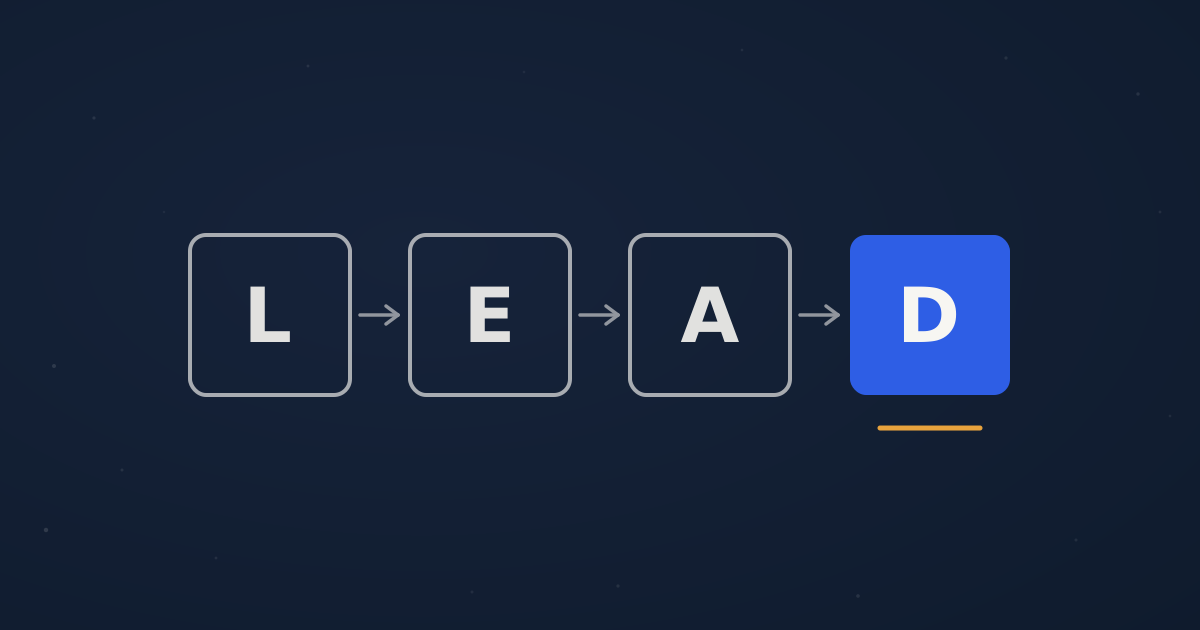
The LEAD System is a four-phase method for running a working life that no longer fits in your head: Lighten, Evaluate, Assign, Digitize. It was created by Issam Sultan, and it is the method Optimate is built on. This post explains each phase plainly enough that you could run the whole thing with a notebook, then explains why most people should not have to.
The method exists for a specific person: the consultant, freelancer, or founder whose business is herself. Her work arrives through email, chat, calls, and 2 a.m. thoughts. Nothing gets done unless she does it or arranges it. There is no colleague downstream to catch what she drops. For that person, the usual advice (“just use a task app”) misses the problem. The problem is not a missing app. It is that the whole system lives in one head, and heads are terrible at storage.
LEAD replaces the head with four moves, in a fixed order.
The four phases at a glance
Lighten
Cut what doesn't earn its place
Evaluate
Prioritize ruthlessly
Assign
Transfer ownership
Digitize
Make it repeatable
Lighten
Cut what doesn't earn its place
Evaluate
Prioritize ruthlessly
Assign
Transfer ownership
Digitize
Make it repeatable
Each phase produces something the next phase needs. Lighten produces the honest list. Evaluate turns the list into decisions. Assign gives every kept item an owner. Digitize gives the whole thing a permanent written home. Skip a phase and the one after it runs on missing input, which is why the order is not a suggestion.
Here is each phase in detail.
Phase 1: Lighten
Lighten means getting every commitment, worry, and half-idea out of your head and into one written list. Not organizing. Not prioritizing. Just surfacing.
Take Sara, a brand consultant with three clients. Her Lighten pass takes about forty minutes and produces 61 items: send the March invoice to her retainer client, call the accountant back, renew the domain that expires in May, reply to the prospect who went quiet, an idea from Tuesday for a client talk, buy a new laptop charger, and 55 more. Big and small on the same list, deliberately. The point is completeness, not tidiness.
The list looks worse than she expected. It also feels lighter than she expected, and that is not a contradiction.
Key Insight
Why writing it down works
A task in your head is stored as worry, and worry has no off switch: it resurfaces in the shower, in a client call, at 2 a.m. The same task written on a list you trust is stored as text, and text waits quietly until you come back for it. The weight was never the task. It was the rehearsing.
Lighten comes first because you cannot make good decisions about commitments you have not surfaced. Every later phase works on this list. An incomplete list quietly poisons all of them, because the items you left in your head keep interrupting the system you built to stop them.
Phase 2: Evaluate
Evaluate means deciding what each item on the list actually needs from you. Most items need far less than the anxiety attached to them suggests.
The working question is not “is this important?” Everything on a solo operator’s list feels important, which is why importance sorting stalls. The question is: what happens if this waits a week? There are only three honest answers.
Something breaks. A client relationship, a deadline, a legal or tax obligation. These items get done now or get a scheduled slot this week. Sara’s March invoice is here: unbilled work is a loan she did not agree to make.
Someone will nudge me. The world has a built-in reminder for these. They can wait, but they need a written date so the nudge does not arrive as a surprise. Sara’s domain renewal goes here, parked with a note for the first week of May.
Nothing happens. Then it is either dead, and gets deleted without guilt, or it is a someday idea, and gets moved to a someday list where it stops pretending to be work. Sara’s Tuesday idea for a client talk lands there. It is a good idea. It is not a task.
The trade-off is real: some parked items will flare up earlier than the date you gave them. That is fine. The fix is the written date, which caps how long anything can hide, not a longer analysis up front. Ten seconds of judgment per item beats ten minutes of scoring, because the scoring system is one more thing you would have to maintain.
The output of Evaluate is short: a this-week list you believe, a parked list with dates, and a pile of honest deletions.
Phase 3: Assign
Assign means every item you kept gets exactly one owner, and the owner is not your memory.
For a team lead the owner is often a person. For a business of one, the owner is usually something else: a contractor, a virtual assistant, a template, a checklist, a calendar entry, software, or an AI assistant. Delegation with no team is still delegation. The definition that matters is this: moving work to any owner that is not your head. There is a full method for this in how to delegate effectively, even with no team, but the shape is simple: write down the outcome, the deadline, and what done looks like, then hand that written brief to the owner.
Sara assigns her bookkeeping backlog to her accountant with a two-paragraph brief, assigns the domain renewal to a calendar entry, and turns her proposal-writing process into a template so the next proposal starts at 60 percent instead of zero.
The failure mode is quieter than people expect. It is not refusing to hand things off. It is handing off the task while keeping the follow-up in your head. “Did the accountant get back to me?” is now your job again, unwritten, resurfacing at random.
Watch Out
The half-handoff
An assignment without a written return date is not delegated. The task moved to a second location, but the worry stayed with you. Every handoff needs two written lines: who owns it, and when you check. The checking is a calendar entry, not a feeling.
Assign comes third because you can only hand off what you have surfaced (Lighten) and judged worth keeping (Evaluate). People who delegate before those two phases hand off the wrong things: urgent noise goes out the door while the work that quietly matters stays stuck in their head.
Optimate Solo runs your work system for you: free, on your own computer, through Codex on your ChatGPT account. It is ready now.
Get Optimate →Phase 4: Digitize
Digitize means giving the system one permanent written home, plus a routine that touches it daily.
One home, not seven. The specific tool matters less than people hope: a notes app, a document, a plain folder all work. What matters is that the this-week list, the parked items with their dates, the handoffs waiting to come back, and the decisions you have already made all live in the same place, and that you open that place every morning. A system you do not review is a diary. If you want the ground rules for that single home, what a productivity system actually is covers them: the system is the set of decisions, and the app is just the container they live in.
Digitize comes last for a blunt reason: digitizing a broken system gives you a faster broken system. The tool-first instinct, buying the app before doing the thinking, is how most productivity attempts die. By the time you reach this phase, the thinking is done. You are giving a working method a place to live.
Tip
The morning touch
The daily routine can be ten minutes: open the home, read the this-week list, check what came back from handoffs, add whatever landed overnight. Small and boring is the goal. A routine you can run on your worst day is worth ten you can only run on your best.
The honest part: most people never run a method
Everything above works. It also has a cost that method explainers usually skip: the method must be maintained, and it must be maintained most on exactly the weeks you have the least room for it.
The Lighten list goes stale unless new items land on it the day they arrive. Evaluate decisions pile up unless something forces the one-week question regularly. Handoffs come back and sit unread. The daily touch gets skipped on the busy Tuesday, then the busy Wednesday, and three weeks later the written home is a museum of who you were in March.
None of that means the method is wrong. It means a method is a job, and a solo operator already has all the jobs. Most people do not want to study a method, or maintain one. They want what the method produces: a head that is quiet at night because the work is written down somewhere trustworthy.
That gap, between a method that works and a person with no room to run it, is exactly why Optimate exists.
How Optimate runs the LEAD System
Optimate Solo is a free work system for solo operators with the LEAD System built into it. You do not learn the phases. You show up to a short daily session, and the phases run in the background of an ordinary conversation.
It works through your own ChatGPT account on your own computer: ChatGPT Plus recommended, about USD 20 per month, paid to OpenAI. Everything stays on your machine.
Inside the daily session, the method looks like this. The session starts by catching you up and asking what is on your mind, which is Lighten happening every morning in small doses instead of once, heroically, in a crisis. What arrived gets filed and the one-week question gets applied, which is Evaluate without a matrix in sight. Your handoffs and their return dates are held and surfaced when due, which is Assign with the follow-up worry taken off you. And because the whole exchange is written down and kept on your machine, Digitize is not a phase you perform. It is just where you already are.
To be clear about the limits: Optimate is a folder of plain files you set up once on your own computer, and it works only while your computer is on and Codex is open. It is a daily session you show up to, usually shorter than a coffee. The method does the same work it would do on paper. You just stop being the one who maintains it.
Method or product: how to choose
If you like building systems, build this one by hand. The four phases above are complete, they cost nothing, and the fuller version for someone whose business is themselves is laid out in a productivity system for solo professionals. Run it in a notebook for two weeks before you commit to any tool.
If you read the maintenance section and felt tired, that is information too. The method was designed so its results do not require your discipline to survive a bad month. That is what Optimate is for: the LEAD System, running, without being learned.
How it works
See what actually happens, from hello to week two.
One page walks you through Optimate: the setup conversation, your first morning brief, and the week it starts sounding like your business.
Walk through itFrequently asked questions
What does LEAD stand for?
LEAD stands for Lighten, Evaluate, Assign, Digitize. The four phases run in that order: get every commitment out of your head and onto one list, decide what each item actually needs, give every kept item an owner that is not your memory, then move the whole system into one written home you review daily.
Who created the LEAD System?
Issam Sultan created the LEAD System for people who run a business of one: consultants, freelancers, and founders whose work does not fit in their head anymore. It is the method Optimate is built on.
Do I have to learn the LEAD System to use Optimate?
No. The method is built into Optimate, so it runs during a short daily session without you studying anything. Knowing the phases helps you understand why the session works the way it does, but it is not required.
Can I use the LEAD System without Optimate?
Yes. The four phases work with a notebook, a plain text file, or any notes app you already have. The method is free to run by hand. Optimate exists for people who want the results of the method without maintaining it themselves.
How is the LEAD System different from GTD?
Both start by getting everything out of your head. LEAD differs in two places: handing work off is its own phase rather than a footnote, and the method ends by moving the system into a single written home with a daily routine attached. LEAD is also smaller on purpose: four phases you can hold in memory, built for one person rather than an organization.

Issam Sultan
· Founder, OptimateIssam Sultan is the founder of Optimate and the creator of the LEAD System, the method Optimate is built on. He writes about running a business of one without carrying it all in your head.
Related articles

How to Start With AI When You're Not Technical
Overwhelmed by AI advice? A calm starting path for non-technical professionals: how the technology works, where to learn, and how not to get ripped off.

Why You Can Trust an AI With Your Files (It's Not About the AI)
Trustworthy AI file organization isn't about smarter models. It's old, proven ideas from banks, kitchens, pilots, and librarians — and what they buy you.