Why You Can Trust an AI With Your Files (It's Not About the AI)
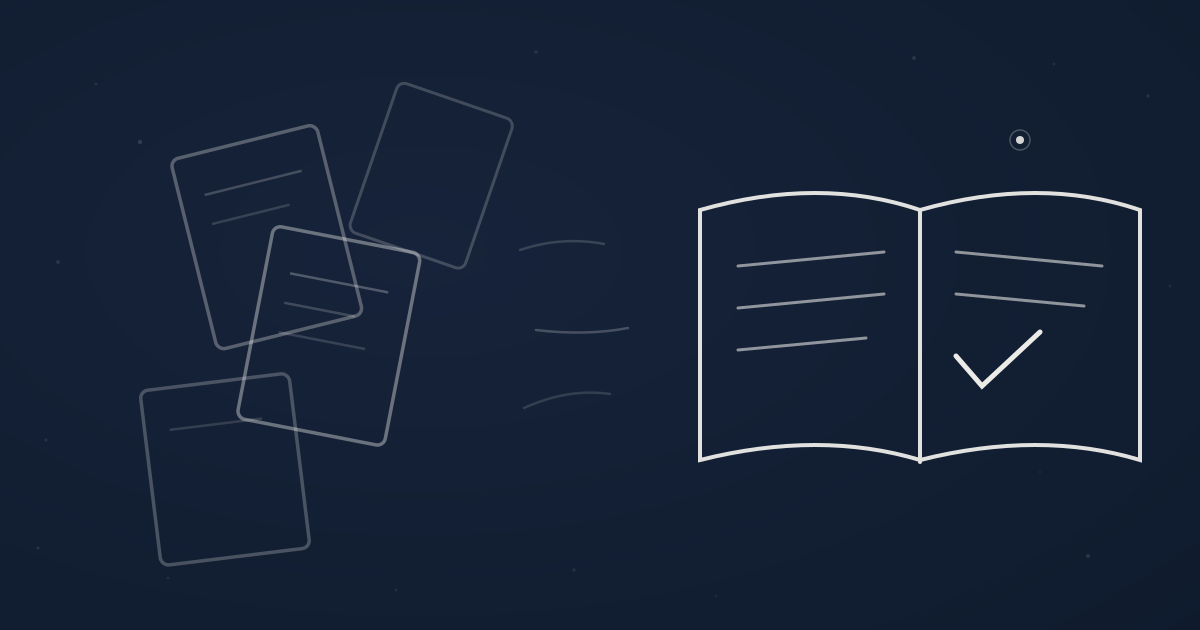
Everyone asks the wrong question about letting an AI touch their files. The wrong question is “is the AI smart enough?” The right question is the one you’d ask about any employee with keys to the building: what happens on its worst day?
We’ve spent months building Optimate around that second question, and the honest answer surprised us: almost none of what makes an AI assistant trustworthy is new, and almost none of it is AI. It’s a stack of old, boring, battle-tested ideas — borrowed from banks, restaurant kitchens, airline pilots, archivists, and one very instructive failure of the modern web. This post is a tour of what we borrowed and, more importantly, what each idea buys you.
From banking: write it down before you touch it
Databases have used a trick for fifty years called the write-ahead log: never change the data until the intention is safely written down first. It’s why your bank balance survives a power cut in the middle of a transfer — the bank knew what it was about to do before it did it, so it can always finish the job or put things back.
An AI that moves your files deserves the same standard. Before a single file moves, the move gets written to a log — from where, to where, why. Which means a crash, a closed laptop, or an interrupted session can never lose your work mid-flight. The intention survives even when the session doesn’t.
And the log has a second life: it makes undo possible. “Put yesterday’s filing back where it was” is only a one-sentence request when every move is on paper. That sentence — nothing is lost, everything can go back — is the entire foundation of trusting an assistant with things you can’t afford to lose.
Key Insight
The one question that sorts all AI tools
Before you let anything organize your files, ask: “can it show me what it changed, and can it put it back?” Every other feature is decoration on top of that answer.
From banking, again: statements
Nobody trusts a bank that takes deposits and issues no statements — even a perfectly honest one. It’s not about suspicion. It’s that verifiability is what lets vigilance relax. You only stop mentally tracking your money because you can check it, any time, for free.
Your working life deserves statements too. An assistant that quietly holds your open loops, watches what you’re waiting on, and keeps tomorrow’s first step saved should show you that — a short, dated “held for you” note you can glance at, and a weekly one-page summary of what it did and, crucially, what it wasn’t sure about. An assistant that volunteers its own uncertainties is doing something no confident-sounding chatbot does: giving you cheap, early chances to correct it, instead of expensive, late discoveries.
This is also the deeper cure for the 2 a.m. problem. If your head is holding your whole system, it’s because your head doesn’t trust anything else to hold it. Heads only put things down when checking costs nothing.
From psychology: a shelf is not a backlog
Here’s a strange and useful fact from a century of psychology — the Zeigarnik effect: unfinished things occupy your mind rent-free. A folder of ten thousand old files marked “to sort someday” quietly costs you at dinner, in the shower, at 2 a.m. The same ten thousand files marked “shelved, dated, retrievable on request” cost you nothing. The files didn’t change. The open loop closed.
That’s why an honest assistant doesn’t pretend it will read your decade of history file by file — at forty careful files a session, ten thousand files is years, and any tool that doesn’t say so out loud is performing competence rather than having it. The trustworthy move is arithmetic first, then an offer: everything older than a date you pick goes onto a clearly labeled shelf — unread, untouched, fully reversible — and real attention goes to what’s actually alive. One afternoon instead of a fictional someday, and your mind gets to file the whole pile under handled.
(Professional archivists learned this exact lesson decades ago. Item-by-item cataloging buried the world’s archives in backlogs until the field flipped to describing collections first and items only where it matters — and the backlogs collapsed. Real librarians don’t catalog every page either.)
From the CRM graveyard: the contact book that writes itself
If you’ve ever bought a CRM and quietly abandoned it, you already know why they fail: every CRM is an empty database demanding data entry, forever, from the one person who has no time. You did the right thing by quitting.
But flip it around. Fifteen years of your files — invoices, contracts, email attachments, proposals — already contain your professional world. The data entry already happened; it just happened as work, not as filing. So an assistant that reads your files as it organizes them can do something no CRM ever could: introduce you to your own contact book. “I keep running into the same name across three invoices and a contract — want me to keep a card for her?” Every card cites where its facts came from, and every future session quietly keeps it current.
And because lock-in is the other way these tools betray you: the cards live as plain files you can read, and they can leave in the same universal formats your phone speaks — vCard for people, the calendar standard for tasks. Your data can walk out the door any day, in formats the whole world reads. Data that can leave is data you still own.
Optimate Solo runs your work system for you: free, on your own computer, through Codex on your ChatGPT account. It is ready now.
Get Optimate →From the E-Myth: delegation without the briefing tax
Why can’t solo professionals delegate? The most-recommended small-business book ever written — Michael Gerber’s E-Myth — is essentially three hundred pages on one paradox: your business is trapped inside your head until the how-to is written down, and you’ll never write it down because you’re too busy doing it. Explaining the task takes longer than doing the task, so everything stays yours forever.
Two borrowed ideas dissolve this. First: an assistant that’s been organizing your files for weeks has already been briefed — every contact card and project note is a briefing that happened as a side effect. So when it drafts your follow-up or preps your client meeting, it shows its receipts (“I used what I know: the March invoice is unpaid; you quoted the retainer rate”) and the briefing tax is zero. For the first time, handing something off costs less than doing it.
Second: the same trick works on your know-how. An assistant that listens while you do a recurring task once can write the steps down as you work — no interview, no documentation homework — and hand you back a one-page how-to that a future helper could follow. The E-Myth’s forty-year-old trap, dissolved as a side effect of a Tuesday.
There’s a cousin of this for decisions, too. Companies survive their own forgetfulness through precedent — “we settled this in Q2, here’s the memo.” Working alone, every settled question silently reopens forever; the real tax isn’t making decisions, it’s re-making them — which is half of what decision fatigue actually is. An assistant that keeps your decisions on file, with your reasons, gives a staff-of-one the thing only institutions used to have: a memory that outranks a tired evening.
From cookie banners: how not to ask permission
The modern web ran one giant, accidental experiment in consent design, and the result is that the entire planet now clicks “accept all” without reading. Legally, that’s consent. Humanly, it’s surrender — and designers drew the right lesson from it: the frequency of asking is itself a privacy feature.
An assistant that asks permission for every tiny action doesn’t feel respectful; it wears you down until you grant it everything just to make the asking stop — which is the least private outcome possible. The trustworthy design asks rarely and means it: a few plain choices made once (“ask me each time” / “move faster in batches” / “work freely, ask only for sensitive things”), honored consistently — and a short list of protections that survive any grant, because a tired click at 11 p.m. shouldn’t be able to give away the things that matter most.
From the kitchen, the flight deck, and Chrome: the craft section
Three last borrowings, quick ones, because they show up as things you feel rather than see:
Mise en place
Prep happens in the kitchen, not at your table — your AI plan pays for your work, not for the system reading its own manuals
The flight simulator
Failures get rehearsed before release — crash mid-move, undo a bad filing day, recover from an interrupted session — until recovery is boring
The invisible update
Improvements arrive in one sentence and one minute, because a fix only counts if it actually reaches you
Mise en place
Prep happens in the kitchen, not at your table — your AI plan pays for your work, not for the system reading its own manuals
The flight simulator
Failures get rehearsed before release — crash mid-move, undo a bad filing day, recover from an interrupted session — until recovery is boring
The invisible update
Improvements arrive in one sentence and one minute, because a fix only counts if it actually reaches you
The kitchen one deserves a sentence more, because it’s about your money. AI plans are metered — sessions have limits, and they’re your limits. A well-built assistant does its heavy reading in the workshop, before it ever reaches you, so your metered minutes go to your actual work instead of to the system studying itself. Same knowledge, radically different bill — and you were the one paying it.
And the pilot one is the deepest of the three. Pilots don’t read about engine failure; they rehearse it in simulators until the recovery is muscle memory. Certification isn’t documentation — it’s demonstrated maneuvers. Hold your tools to that bar: not “the features are listed,” but “someone watched it lose an engine and land.”
The quiet part: an assistant that sleeps when you do
One more borrowed idea, from the corner shop with no alarm system: everything happens in the minute the owner unlocks the door. An assistant built this way — no background process, nothing running while you’re away — cannot watch you, monitor you, or phone home, because it doesn’t exist between your sessions. That’s not a limitation dressed up as privacy; it’s privacy with an engineering guarantee behind it.
And here’s the elegant part: it costs you nothing. “Real-time” is a property of data, not screens — a stock ticker needs a live feed because prices move while you watch, but your files only change while your assistant works. So everything is perfectly current the moment you sit down, from a system that was fully asleep the moment before.
What to do with all this
If you’re evaluating any AI tool for your working life — ours included — carry the borrowed ideas in as a checklist: a written log before any change, one-sentence undo, statements you can check for free, honest arithmetic about big backlogs, data that can leave in universal formats, permission that’s asked rarely and means something, and failures that were rehearsed before you ever showed up.
None of it is glamorous. That’s rather the point — trust never is. And all of it sits on the same foundation every solo professional needs with or without AI: one home for your work, a daily start, and a weekly review — the bones of a full working system for solo professionals. The old ideas run the system. The AI just finally makes them effortless.
How it works
See what actually happens, from hello to week two.
One page walks you through Optimate: the setup conversation, your first morning brief, and the week it starts sounding like your business.
Walk through itFrequently asked questions
Is it safe to let an AI organize my files?
It is as safe as the rules around it. The AI itself matters less than three guarantees: every change is written to a log before it happens, any bulk change can be undone with one plain-English request, and a backup runs automatically before anything big. Ask any tool those three questions before you hand it your working life.
Can I undo what an AI does to my files?
With a well-designed assistant, yes — and this is the single most important thing to check. Look for a written record of every move and a one-sentence undo, like "put yesterday's filing back." If a tool cannot reverse its own bulk actions, it is asking for trust it has not earned.
Will my data be locked into one AI tool?
Only if you accept a tool that stores your information in a private format. Keep your working life in plain, human-readable files, and check that contacts and tasks can leave in universal formats like vCard and iCalendar — the same ones your phone already speaks. Data that can walk out the door any day is data you still own.
Does an AI assistant need to watch my computer all the time?
No, and it is worth preferring one that doesn't. An assistant that only exists while you're actually working with it cannot monitor you, phone home, or act while you're away — and since your files only change while it works, everything is still perfectly current the moment you sit back down.

Issam Sultan
· Founder, OptimateIssam Sultan is the founder of Optimate and the creator of the LEAD System, the method Optimate is built on. He writes about running a business of one without carrying it all in your head.
Related articles
How to Organize Your Digital Workspace in One Afternoon
A one-afternoon fix for a scattered digital workspace: one home for active work, a forwarding rule for every inbox, and file names future-you can search.

How to Start With AI When You're Not Technical
Overwhelmed by AI advice? A calm starting path for non-technical professionals: how the technology works, where to learn, and how not to get ripped off.